I like reading and writing about methods, which may seem a very strange quirk, but I can ensure it is useful. I have never considered myself a method expert, despite teaching a qualitative method class where I played the role of the interviewee in fake student interviews in a way that was so funny, I got stellar teacher evaluations (this is where doing improv provides you with more skills than teaching certificates).
Recently, I got invited to speak about methods in different venues, and I had the impression that people are interested in learning methods to study digital content. So, I decided to put here some resources that can be useful to many.
Just to clarify, I am mainly a qualitative scholar, and I am not an expert in digital humanities. Most of what I do is look at texts I find online and analyze them with various qualitative approaches in mind. Here’s a list of my favorites with examples:
1) Critical Discourse Analysis (CDA)
When is it useful? I use it when I want to understand power relations within language. For instance, when looking at religious minorities, gender minorities, sexual minorities…
How do I collect & analyze data? CDA does not need a huge corpus, I usually just manually select texts/documents and manually analyze them.
Do you have recommended readings?
- Fairclough, N. (2010). Critical Discourse Analysis: The Critical Study of Language (2 edizione). Routledge. This is a classic
- Sengul, K. (2019). Critical discourse analysis in political communication research: A case study of right-wing populist discourse in Australia. Communication Research and Practice, 0(0), 1–17. https://doi.org/10.1080/22041451.2019.1695082 This is about political communication, but I find it very useful
- Evolvi, G. (2018). Exploring Digital Spaces: Combining Critical Discourse Analysis With Interviews to Study a Muslim Blog. SAGE Publications Ltd. https://doi.org/10.4135/9781526447623 a bit of self promotion, and here I also talk about interviews.
Do you have an example?
This example shows how language in the court cases of the European Court of Human Rights frame Islam and Catholicism in different ways, implying that the Muslim veil is “proselityzing” and “ostentatious”, and the Catholic crucifix is not.
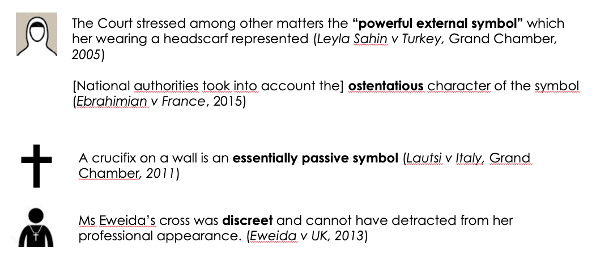
This comes from the article: Evolvi, G., & Gatti, M. (2021). Proselytism and Ostentation: A Critical Discourse Analysis of the European Court of Human Rights’ Case Law on Religious Symbols. Journal of Religion in Europe, 14(1–2), 162–188. https://doi.org/10.1163/18748929-20211524
2) Thematic Analysis
When is it useful? This is a good qualitative approach when I have a medium-big qualitative dataset and I want to find patterns and themes. I sometimes combine it with other approaches, like CDA
How do I collect data? You can do machine-assisted data scraping, or manual collection through APIs or keyword search. I often used Atlas.ti for coding, and it’s useful because you can also look for frequencies and save quotes. There are other programs, like Nvivo, able to do this, and my choice of Atlas.ti is the number one reason scholars use something: my university had it for free.
Do you have recommended readings? Virginia Braun and Vitoria Clarke are the must-read of the topic, and they put together a wonderful list of resources here: https://www.thematicanalysis.net/
Do you have an example?
This is a table created by a former graduate student with whom I co-authored a paper. She created more than 200 codes, and then grouped them in categories and themes. There were six themes, which, for the sake of the article, were discussed in three sections.
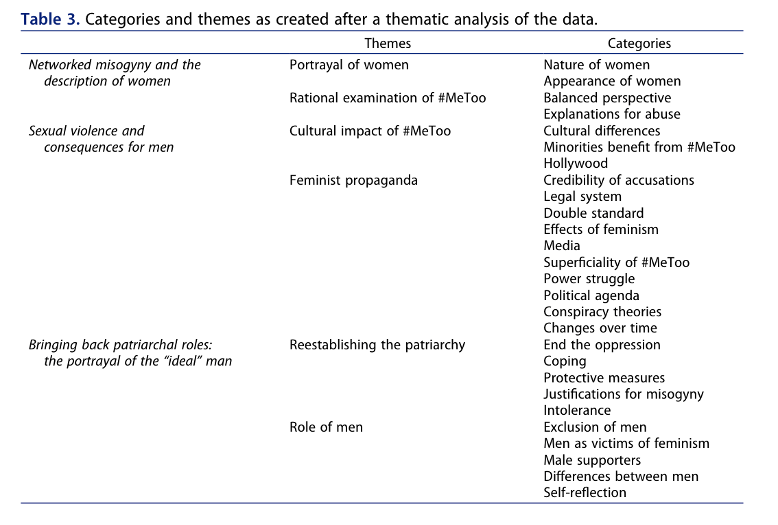
This comes from the article: Dickel, V., & Evolvi, G. (2022). “Victims of feminism”: Exploring networked misogyny and #MeToo in the manosphere. Feminist Media Studies, 0(0), 1–17. https://doi.org/10.1080/14680777.2022.2029925
3) Sentiment Analysis
When is it useful? When I am interested in knowing people’s opinions and emotions about a topic. It’s used in different fields, but I find it useful when it comes to controversial topics and I want to explore the dominant opinions.
How do I collect data? I used tweets collected through the Twitter API (as long as Elon allows us to do it…). There are several tools to do a sentiment analysis, but I wasn’t convinced by them, and I did it manually. It takes longer and some may argue is not a “typical” sentiment analysis, but I could better detect irony and ambiguous statements.
Do you have recommended readings?
- Ceron, A., Curini, L., Iacus, S. M., & Porro, G. (2013). Every tweet counts? How sentiment analysis of social media can improve our knowledge of citizens’ political preferences with an application to Italy and France. New Media & Society, 1461444813480466. https://doi.org/10.1177/1461444813480466 As mentioned, there are many applications of sentiment analysis to marketing, this article is about political preferences and was useful for my research.
Do you have an example?
I did a study of how Islam was discussed together with the hashtag “#Brexit” after the British referendum, and the sentiment analysis helped me show the volume and types of Islamophobic content (also in relation to dominant keywords)
A method note: when I got the Italian habilitation to be a professor (abilitazione), I got praise for this article for being a thorough quantitative study, but I see this as a qualitative one as it has a relatively small sample and I did manual coding and analysis.

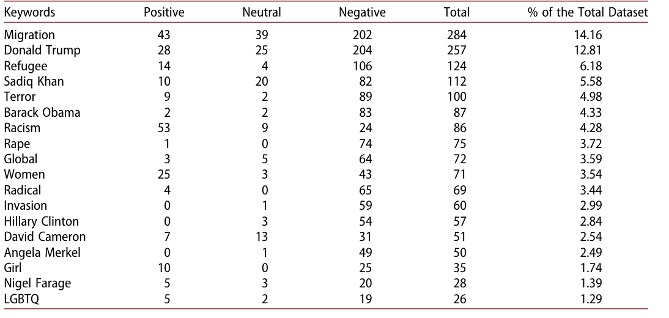
This comes from the article: Evolvi, G. (2017). #Islamexit: Inter-group antagonism on Twitter. Information, Communication & Society, 22(3), 386–401. https://doi.org/10.1080/1369118X.2017.1388427
4) Topic Modelling and Semantic Analysis (aka Big Data Analysis)
When is it useful? This is a useful approach when a study wants to consider a big corpus of data in a quantitative way
How do I collect data? Scraping from Twitter (or other platforms) API – as long as Elon allows –followed by a machine-assisted analysis, using programs such as Python. Full disclosure: I’m not a coding person (yet), and I have achieved this type of analysis with the help of my brilliant former colleague Frederik Elwert.
Do you have recommended readings?
- Fabre, C., & Lenci, A. (n.d.). Distributional Semantics Today Introduction to the special issue. hal-01259695 https://hal.science/hal-01259695 a useful overview from an open access archive
- Blei, D. M. (2012). Probabilistic topic models. Communications of the ACM, 55(4), 8. https://doi.org/doi:10.1145/2133806.2133826
Do you have an example?
When Notre Dame burned, a lot of people talked about it on social media (it was, indeed, a blessed moment in the world with no pandemic and no terrible conflicts near us). We collected tweets discussing the event, looked at frequencies of topics and how people used emojis to discuss their emotions.
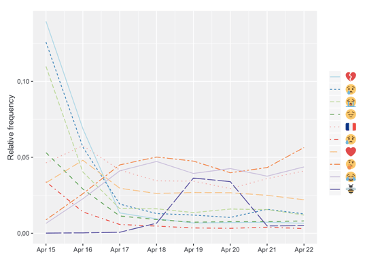
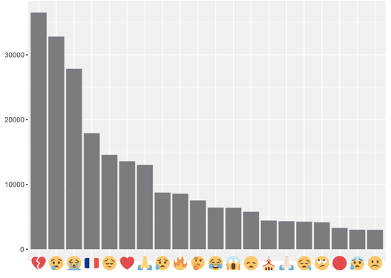
This comes from the article: Elwert, F., Evolvi, G., Neumaier, A., & Wildt, K. de. (2023). : Emoji and Religion in the Twitter Discourses on the Notre Dame Cathedral Fire. Journal of Religion, Media and Digital Culture, 11(2), 198–226. https://doi.org/10.1163/21659214-bja10071
Finally, I am doing a Corpus Linguistics analysis, but this is still a work in progress, so I’ll probably update the post later. In the meantime, I also suggest this additional reading to get data from social media:
- Di Cristofaro, M. (2023). Corpus Approaches to Language in Social Media. Routledge. https://www.routledge.com/Corpus-Approaches-to-Language-in-Social-Media/Cristofaro/p/book/9781032125701
Feel free to contact me for questions, criticisms, or suggestions. Some of these methods are works in progress for me as well, but hopefully this post can be useful to get an idea of how a scholar can approach social media.
 Giulia Evolvi
This is an excellent overview to the practice of analyzing social media for meta-trends. As someone who has done a little bit of work with data analysis and visualization, I appreciate the perspective shared here.
LikeLike