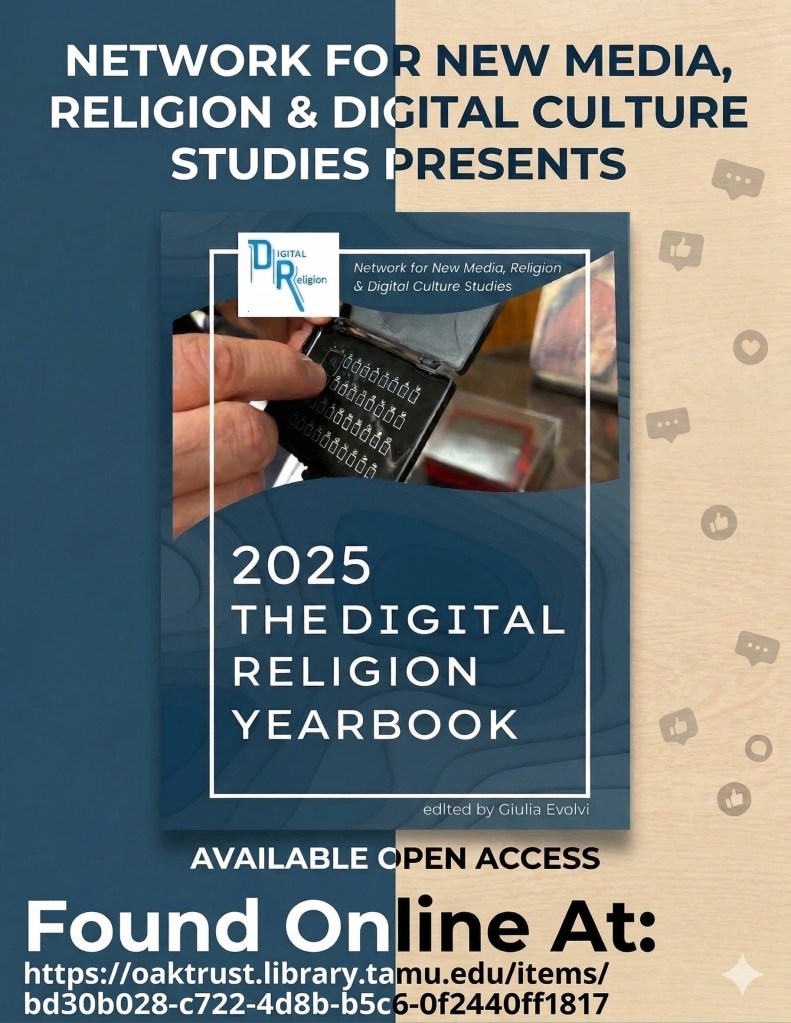
I have the privilege of being the person putting together the Digital Religion Yearbook, which is a yearly open access publication from the Network for New Media, Religion & Digital Culture that highlights the best research in Digital Religion. This is my introductory note where I explain why the 2025 yearbook’s focus is on gender.
To read the Digital Religion Yearbook: https://oaktrust.library.tamu.edu/items/bd30b028-c722-4d8b-b5c6-
I have been focusing on Digital Religion for several years and, in my second year as Assistant Director of the Network for New Media, Religion, and Digital Culture, I am extremely pleased to see the field evolving in new and exciting directions. Reflecting on my experience, Digital Religion is a field shaped by many incredible people, and, specifically, many incredible women. I think I speak for all Digital Religion scholars when I say that Network Director Heidi Campbell is the one who created and substantially shaped the field, which would not be the same without her. Presently, Alessandra Vitullo is bringing the NNMRDC forward by creating spaces, opportunities, and connections, both in terms of ideas and people, and I have a lot of hope regarding her role as Associate Director. In thanking these two, I also think of all the women whose careers have inspired me, whose articles have enlightened me, and whose research made me want to continue working on Digital Religion.
In focusing this Yearbook on gender, I have in mind, first and foremost, the women who shaped the field of Digital Religion. Furthermore, I’m thinking of gender as an object of study. I am focusing on the topic of gender as I look at how Catholics use online spaces to discuss it from various political and social standpoints, in a transnational perspective. To me, the study of gender is not only “done by women” or about “studying women,” but rather it is an attention to people who have been traditionally overlooked. Being able to capture the experience of Digital Religion outside of traditional male-centered investigations means understanding those who are too often excluded, and analyzing voices that are sometimes difficult to hear. In an intersectional perspective, the study of gender opens venues of inclusion for people of different races, ethnicities, sexual orientations, (dis)abilities, and classes. When we’re able to empower half of the world that has been traditionally excluded from academia and established religious institutions, we gain a new sensibility that helps us understand more nuances of the human experience.
When discussing the topic of gender with NMRDC members, we all agreed that Kristin Peterson was the ideal scholar to write the Annual Essay for this Yearbook. Focusing on examples of digital activism by Christian and Islamic women, she can explain the tension between feminism and established religious institutions that uphold patriarchal norms, and the role of digital media in addressing this issue. Furthermore, her exploration of new age spirituality and online wellness content elicits important reflections on how women create videos and narratives that are not marginal to algorithmic logics, but are deeply entangled with neoliberalism, marketing, and contemporary (post) feminism. With Kristin Peterson’s essay, we hope to invite scholars in Digital Religion to think about theories and methodologies to address the rapid evolution of digital technologies, including phenomena that might not seem as connected to religion, like activism, influencer culture, or mental health.
Every year, a remarkable paper wins the Digital Religion Research Award. This year the paper was chosen from those published on the Journal of Religion, Media, and Digital Culture, and it is Kathrin Trattner’s article “Between Feminist Solidarity and “Bible-Verse-Throwers”: Catholic Feminist Activists on Social Media and Experiences of Agency.” This research not only fits the topic of gender well, but it is also innovative and though-provoking in exploring the issue of agency in digital spaces. Specifically, it looks at the convergence between online and offline actions to theorize how women build communities and reclaim their narratives. Furthermore, it highlights something relevant when looking at digital culture through the lens of gender: the idea that the Internet can both be a place of empowerment and disempowerment when it comes to religious people.
The Yearbook includes mentions of the top articles, scholars, and students in Digital Religion for 2025. This does not mean, of course, that there aren’t other exceptional works and researchers to be mentioned: every year, it seems increasingly difficult to choose whom to feature in the Yearbook. Rather, starting from the focus on gender, we selected articles that engage with femininity and masculinity, with youth culture and new platforms, and with case studies that focus on regions outside of Europe or North America. Similarly, scholars and students are women and men whose work is about dissident online voices, digital narratives on patriarchal norms, representations of gender in media, and the evolution of various gender-based groups within religious institutions. With the final section, about NMRDC members’ publications, we hope to offer an overview of how the field of Digital Religion is moving towards understanding religious authorities, identities, communities, and authenticity in a society that is increasingly characterized by the presence of AI and new technologies.
In 2025, we have seen “gender” growing into a “problematic” term, often at the center of political narratives that point to cultural and social conflicts. As scholars, we do not shy away from potentially controversial terms, but rather, we try to better understand them. The issues around “gender” fuel our research on how Digital Religion helps define, or challenge, politically charged terms. In a society where technological developments seem to exist alongside the increase of polarization, hate speech, and conflicts, our role as Digital Religion scholars is more important than ever. My invitation for 2026 is to think of ourselves as analysts of current affairs, challengers of difficult ideas, and creative minds of a rapidly changing culture.
 Giulia Evolvi